




|
|---|


Thursday, December 29, 2005

The answer isn't quite as obvious as one might think. artificial.dk now has a section about art games, or to put it more correctly - video games made by artists. How is that for a pompous way of promoting entertainment, giving it the special "art" status? Of course, some of the works are actually quite far from what one could call a game see, for instance, in the featured selection art games several works are really "hacked" games, made impossible to play or turning the concept of "game" meaningless. The work might be interesting, but isn't calling it a "game" just a pretensious way of promoting "alternativity"?
On the other hand, many art games seem to be just plain games, i.e. entertainment, under an artsy cover. They get you hooked just the same, and the esthetic aspect seems to vanish in the competitive haze. That's what happened to me with arteroids, a game I linked to some time ago. (I even clearly called it a "game", suggesting I don't quite feel arteroids are as "artsy" as its creator Jim Andrews wishes to see them)
The Intruder by Natalie Bookchin is another case. Here is a narrated story, accompanied by several "games", some of which are playable, others, well, symbolic or rather, playing on the idea of playing. It has a low-fi, underground feel to it that makes it at once appealing and irritating. Appealing, because contrary to some all-too-perfect projects, there is lots of room for us here, for changing focus, for trying to figure out a personal way of going through this. Irritating, because when I played (?) it, several times the game seemed to stop or stall. The limit of my low-fi enthusiasm appears just about here.
Technorati:
Wednesday, December 28, 2005
There are some works of art that stupid people will never understand because they weren't made for stupid people. And there are a lot of stupid people. Why should anyone assume that any work of art can be reduced to the level of comprehension of a contemporary eight-year-old?- Robert Hughes (from this interview)
 Paula Rego, Girl Lifting Up Her Skirt to a Dog
 Many consider Hughes the best art critic in the world. This is his most famous and witty book about contemporary art:
In the preface, he asks: "What has our culture lost in 1980 that the avant garde had in 1890?"
And answers: "Ebullience, idealism, confidence, the belief that there was plenty of territory to explore, and above all, the sense that art, in the most disinterested and noble way, could find the necessary metaphors by which a radically changing culture could be explained to its inhabitants."
The thought is impressive. It inspires to lift one's butt and find those necessary metaphors.
But I have some doubts. The idea that art should "find metaphors", and that they are to be the "necessary metaphors", seems both scary, and distant from a modernist perspective. Conveniently, Hughes gives the example of the Eiffel Tower, which was not, however, your typical artistic enterprize of the time. Of course, today we might see it as such, but putting it as a prototype of a work of art of that era it is a projection of our today's perspective.
Doubt #2: The Van Goghs and Gaugins, and even the futurists, were not quite the "culture". They were clearly the avant garde. And with this noble classification came a marginal social status. Thus, we cannot compare today's culture to yesterday's avant garde. Those are simply different worlds. The question might be - do we still have an avant garde? Well, did the average art lover of the 1890's know what was the true, valuable avant garde (as seen by us today)? Of course, we are not just your average art lovers. We are - us. And so we know.
Does an avant garde still have any sense? Or is art so institutionalized it's impossible to see it as this fresh, new force?
I am deeply convinced that avant gardes still exist, as always, in plural, and as always, difficult to see, maybe not as much for aesthetic, as for political reasons. The avant gardes that have prevailed (that we know) seem to be those that have been taken up by some political/social movement. And those movements are yet to come. Today's social currents pick up yesterday's avant gardes and turn them into what we know - starry starry nights and eiffel towers.
Tuesday, December 27, 2005
The Polite Umbrella, by Joo Paek, respects people’s personal space in a public area. This shrinkable umbrella enables users to morph its shape like a jellyfish in order to reduce occupied space and to increase user maneuverability.
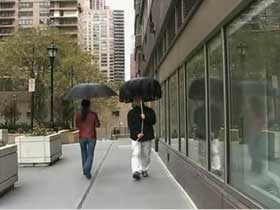
The user can adjust their umbrella by pulling a handle so that one can protect themselves from harsh winds or bumping into others. The video.
(via)
Technorati:
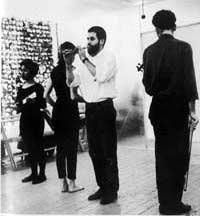
A key event in the history of modern performance was the presentation in 1959 of Allan Kaprow's 18 Happenings in 6 Parts at the Reuben Gallery. (...)
Kaprow chose the title "happening" in preference to something like theatre piece or performance because he wanted this activity to be regarded as a spontaneous event; somethink that "just happens to happen." Nevertheless, 18 Happenings, like many such events, was scripted, rehearsed, and carefully controlled. Its real departure from traditional art was not in its spontaneity, but in the sort of material it used and its manner of presentation. In his definition of a happening, Michael Kirby notesthat it is a "purposefully composed form of theatre," but one in which "diverse alogical elements, including non-matrixed performing, are organized in a compartmental structure." "Non-matrixed" contrasts such activity to traditional theatre, where actors perform in a "matrix" provided by a fictional character and surroundings. An act in a happening, like Halprin's "task-oriented" movement, is done without this imaginary setting. In Alter's terms, it seeks the purely performative, removed from the referential. The "compartmental structure" relates to this concept; each individual act within a happening exists for itself, is compartmentalized, and does not contribute to any overall meaning.
- Marvin Carlson
Quoted from:
Subscribe to:
Posts (Atom)


